|
|
|
Collimation Testers
Testing Collimation
Using Shearing Interferometry
Manfred W. Grindel
Abstract
The collimation tester is one of the simplest devices available for
examining optical wavefronts. Based on a shearing interferometer, its
sensitivity can be adjusted as required. Methods of use in collimating
laser beams will be described, in addition to other applications involving
planarity. Versatility in wavelength coverage will be discussed.
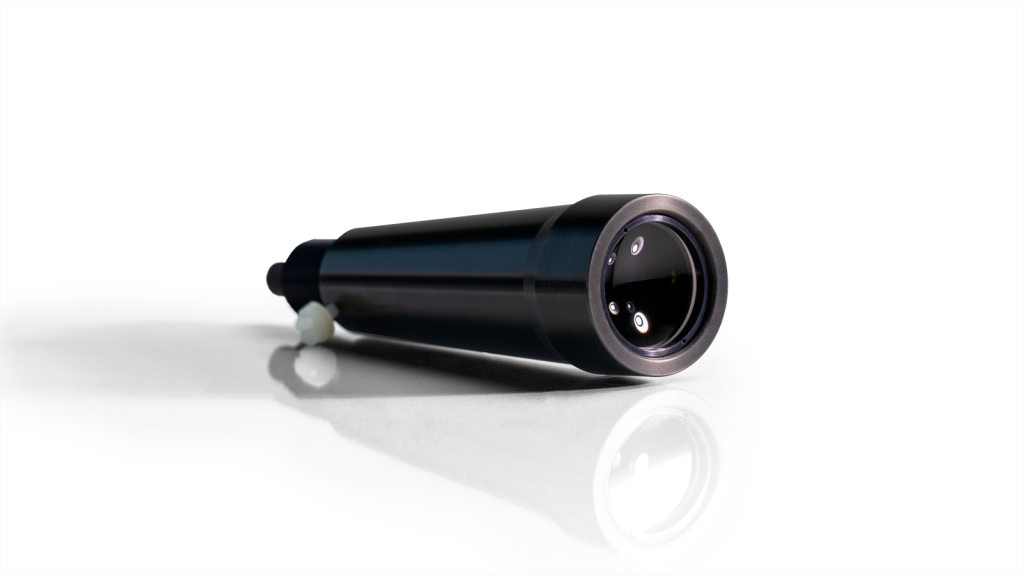
The collimation tester is basically
designed as a null device to establish the collimation of laser light.
This is done by adjusting whatever collimating optics are being used until
the fringes produced by the tester are observed to be aligned to a preset
cursor wire. This avoids the problems of estimating or measuring beam
diameter over some range of distances, calculating divergence and
comparing the results to expectations. With perfectly plane or spherical
wavefronts, straight fringes are obtained. Any departure from straightness
or wiggles are indicative of aberrations in the system.
The collimation tester consists of a piece
of high quality BK-7 with very flat surfaces having a slight wedge angle
between them. When a plane wave is incident at an angle of 45°, two
reflected wavefronts result. These are separated laterally because of the
plate thickness and angularity due to the wedge. The lateral separation is
referred to as shear which is why the device is referred to as a shearing
interferometer. With plane wavefronts incident, the area of overlap
between the two reflected beams will show fringes when projected on a
screen. The fringes will appear solely from the wedge angle and their
spacing will be
where f is the fringe spacing,
is the wavelength, N is the refractive index and
is the wedge angle. These fringes will be perpendicular to the wedge
orientation and parallel to the wire cursor stretched across the
collimation tester.
Should the incident wavefront be spherical
instead of plane, another factor is introduced; the incident wavefront on
a plane parallel is without any wedge, as in Figure 2.
The two reflected wavefronts are separated by the shear. If the wavefront
radius is very large compared to the plane thickness, the condition is
just like that of the Young two-pinhole experiment. You have radiation
coming from two virtual point sources, separated by the shear, S, at a
distance of R, the wavefront radius. When projected on a screen, straight
fringes are seen, perpendicular to the shear direction, with a spacing of .
If we now substitute the collimation tester for the plane parallel, with
the shear direction at right angles to the wedge, the two angles combine.
The two point sources are separated vertically by the wedge angle and
horizontally by the shear. The resulting fringes are perpendicular to the
direction of the separation with a spacing inversely proportional to the
combined angle. As the wavefront radius is increased and made more
parallel, the horizontal angle decreases. The fringes become more
horizontal until the wavefront is plane and the fringes are parallel to
the preset cursor. As the wavefront radius becomes steeper, the fringe
direction deviates more from horizontal, and since the combined angle
increases, the fringe spacing decreases. The collimation tester therefore
has a variable sensitivity. the further from collimation, the lower the
sensitivity, and vice versa. As you go through collimation, from
converging to diverging, the slope of the fringes will change from
positive to negative.
As long as the wavefront radius is large
compared to the plate thickness, and small angle approximations can be
used, the wavefront radius or beam divergence can be calculated from the
measurements with the collimation tester. Simply shown, the radius at the
screen is
where S is the shear, d is the fringe spacing perpendicular to the fringe
orientation, A is the orientation of the fringes with respect to the
cursor and
is the wavelength. All the measurements can be made from the observation
screen. If, because of edge illumination, the shear is not apparent, a
vertical wire or point in the center of the beam will produce two images
whose separation can be measured. The angular divergence of the wavefront
is simply the width of the beam divided by the radius of curvature.
To
be useful in testing collimation, the sensitivity must be examined. As
seen in Figure 4, using a shear equal to half the projected beam width,
and a fringe spacing (near collimation) of one-fifth the diameter, we can
estimate the fringe angle to one-fifth fringe over the shear distance,
which calculated to an angle of 0.08 radians. Putting these values in the
equation for divergence, we arrive at a value of 0.8 /D.
This is approximately the divergence expected from a diffraction limited
plane wave. Under ideal conditions, the collimation tester is accurate to
the theoretical limit in determining collimation. When measuring actual
wavefront curvature, the null setting technique is not used and the values
of fringe spacing, orientation and shear have to be measured, yielding
somewhat higher errors. While the error is a function of a number of
factors, in practice it is found that a wavefront curvature can be
measured to about 0.2%.
The collimation tester was designed to be a
versatile laboratory device useable for a range of apertures, from the
full diameter down to about one-fifth of the diameter. This is the basis
for designing the wedge to have 5-6 fringes.
Fewer fringes would yield a higher sensitivity and would make the device
less useful for smaller diameters. The shear is also designed to be less
than half the diameter for the same reason. The shear is actually variable
as a function of angle of incidence. Figure 5 shows a plot of the shear vs
the incident angle for an index of 1.517. The shear peaks at an angle of
49° with a value of 0.752 times the thickness. The function varies
slowly, however, and at 45° is only 1% smaller, so 45° is recommended
for convenience.
When aligning a laser collimator, the
initial setting may be so far from collimation that the fringes are too
close to be distinguished. In that case, reducing the angle of incidence
will reduce the shear, and consequently the sensitivity.
Since wavefront curvature can be measured,
the collimation tester can be used to measure surfaces with large radii.
Figure 6 shows how this can be done.
The first screen checks for an incident plane wavefront while the second
screen measures the wavefront after reflection from the surface under
test. The wavefront is measured at the screen and the surface-to-screen
distance must be added or subtracted, depending on whether the surface is
concave or convex. The mirror radius is twice the wavefront radius. Murty
has demonstrated that this is the most accurate method of measuring large
radii, other than the multi-conical method recommended by Zygo, which can
only be used with concave surfaces.
The homogeneity of optical components can
also be tested with the use of a well collimated laser source and a
collimation tester. The part is placed in the laser beam and the exiting
beam analyzed as mentioned previously. If the beam is deviated, as in the
case of a wedge or prism, the collimation tester must be oriented
appropriately to the exiting beam. This technique of checking homogeneity
or overall wavefront deformation has the advantage of obtaining single
pass information without the complications of a Mach-Zehnder
interferometer. The overall simplicity and cost compare favorably with
other methods, single or double pass.
In a shearing interferometer, the wavefront
is compared to itself, rather than to a flat reference wavefront, as in
other interferometers. As a result fringe interpretation is quite
different. It has been shown that a change in wavefront curvature will
produce straight fringes, but their slope changes. The analysis of fringe
patterns to derive wavefront aberrations is not the purpose of this paper.
This information is already available in the literature. The collimation
tester has proven useful in the alignment of an off axis parabola where it
can easily be seen whether the wavefront aberration is improving as
adjustments are made. Aberrations can be isolated from defocus by noting
whether the fringes are straighter, even if they are at an angle to the
cursor.
The collimation tester can be used over the
wavelength region of transparency, from about 350nm to past 2000nm.
Account must be taken of the effects on sensitivity of wavelength and
refractive index. The main problem becomes one of "seeing" the
fringes outside of the visible spectrum. Fluorescent screens can be used
in the UV. In the near IR, Kodak phosphor screens, IR image converters and
CCD cameras have been used. For use at longer wavelengths, collimation
testers have been made from calcium fluoride and germanium. Fringes can be
observed by using a pyroelectric vidicon or other IR imager.
One question that has arisen pertains to
the intensity of the fringe pattern. Since the interferometer plate is
uncoated, most of the light is transmitted. Maximum reflection can be
obtained by illumination with the plane of polarization perpendicular to
the plane of incidence. When the surfaces are coated with partial
reflectors, the observed pattern becomes brighter, but multiple images
arise, which becomes confusing to interpret. Attempts have been made to
fabricate collimation testers from partially absorbing materials with
reflective surfaces to both increase the brightness and suppress multiple
images. In principle this works, but the thick pieces of material required
do not have the necessary homogeneity for testing wavefronts to their
theoretical limit.
PRODUCTS |
TECHNICAL |
APPLICATIONS |
CORPORATE |
DISTRIBUTORS
| PRIVACY POLICY
CONTACT US |
CATALOG |
PRICE LIST |
ORDER INFO

.
©2007 Ocean Optics, Inc. All rights reserved.
Terms of
Use and Privacy Statement
+1
727.733.2447 • +1 Fax 727.733.3962 •

|
|

Contact
an
Ocean Optics
Applications Scientist
|