
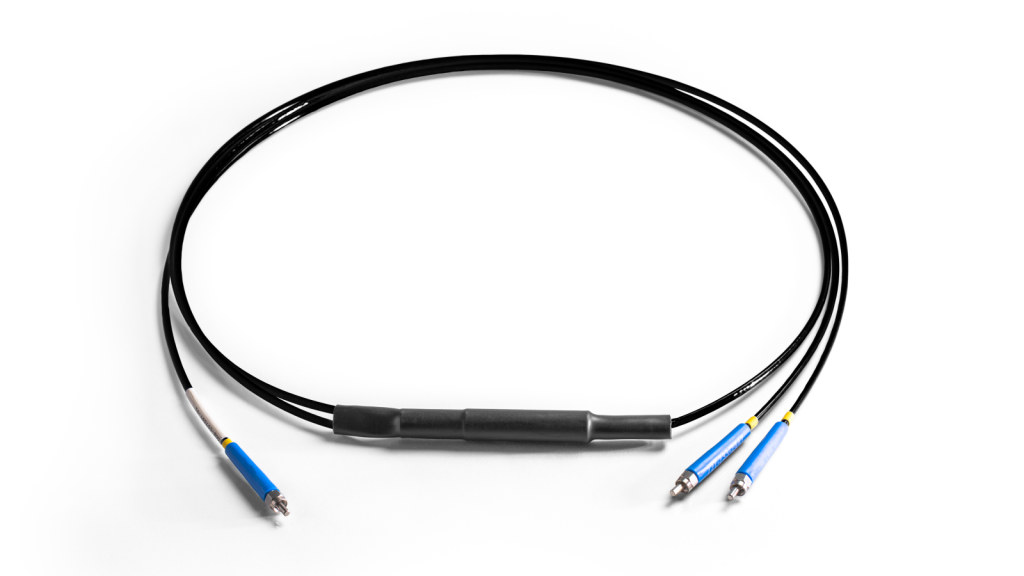
Splitter Assembly
Product Details
A splitter comprises three fibers – two fibers at one end that deliver light into the third fiber at the common end. All the fibers are epoxied together at the nexus of the assembly.
Splitters have lower transmission efficiency than bifurcated fibers.
Key Benefits of Using a Splitter Fiber Assembly over a Bifurcated Fiber
Improved Signal Mixing and Uniformity
Ideal for applications like dual-channel spectroscopy or reference/sample comparisons
Better Control over Split Ratio
Allow precise control of how light is divided
Reduced Crosstalk and Back Reflection
Beneficial in high-sensitivity measurements or when working with low-light signals
Compact and Robust Design
More mechanically stable and compact, with integrated housings that protect the fiber junction
Specifications
Wavelength Coverage
300-1100 nm or 400-2100 nm
| Part Number | Wavelength Range | Core Diameter | Buffer/ Coating | Length (meters) | Jacketing | Bend Radius (cm) | ||||||
| 0.25 | 0.5 | 1 | 1.5 | 2 | Silicone Monocoil | Stainless- steel BX | LTBR | STBR | ||||
| SPLIT200-UV-VIS | 300-1100 nm | 200 μm | Polyimide | X | X | 8 | 4 | |||||
| SPLIT400-UV-VIS | 300-1100 nm | 400 μm | Polyimide | X | X | 16 | 8 | |||||
| SPLIT600-UV-VIS | 300-1100 nm | 600 μm | Polyimide | X | X | 24 | 12 | |||||
| SPLIT200-VIS-NIR | 400-2100 nm | 200 μm | Polyimide | X | X | 8 | 4 | |||||
| SPLIT400-VIS-NIR | 400-2100 nm | 400 μm | Polyimide | X | X | 16 | 8 | |||||
| SPLIT600-VIS-NIR | 400-2100 nm | 600 μm | Polyimide | X | X | 24 | 12 | |||||
Fibers & Probes Product Support
Access specialized tech tips, maintenance guides, and application notes for your equipment.
- Maintenance Guides
- Probe App Notes
- Solarization Info
- Technical Tips