
Precise material analysis is vital for scientific discovery and industrial progress. From ensuring the purity of pharmaceutical ingredients to verifying the composition of alloys in aerospace manufacturing, accurate elemental identification impacts safety and performance.
Laser-induced breakdown spectroscopy (LIBS) is a fast and versatile analytical technique that enables multielement detection in any state of matter. As industries rely on real-time data for decision-making, LIBS can transform how researchers and manufacturers approach elemental characterization. Discover what LIBS is, its advantages and use cases.
What Is LIBS Spectroscopy?
LIBS is a type of atomic emission spectroscopy that uses a focused laser pulse to vaporize a small portion of a sample, forming a high-temperature plasma. As this plasma cools, it emits light wavelengths characteristic of the elements present in the material. The technology provides a quick and accurate determination of the sample’s elemental composition by analyzing these spectral emissions.
LIBS is suitable for analyzing various materials with minimal or no sample preparation, although, in most cases, some sample preparation will result in a better analysis.
How the LIBS Process Works
LIBS operates through a sequence of laser-matter interactions that convert a tiny volume of a sample into plasma. While the entire process occurs within microseconds, it can be broken down into three distinct stages.
1. High-Energy Laser Pulse
The LIBS process begins when a tightly focused high-energy laser pulse is directed at a sample’s surface. Typically, this pulse is generated by a Q-switched Nd:YAG laser, which delivers energy in the range of a few nanoseconds per pulse.
When the laser beam strikes the sample, its energy density heats and vaporizes a microscopic portion of material from the surface. This process, known as ablation, removes a minute quantity of the sample, which creates a volume of vaporized and ionized material that forms a plasma.
2. Creation of Superheated Plasma
The ablated material transforms into a superheated plasma, an ionized gas that reaches extremely high temperatures. Chemical bonds break down, and much of the vaporized material is atomized and then ionized.
This plasma lasts only a few microseconds, but during this brief interval, it contains vital spectroscopic information. The light emerging from the plasma reflects the elemental makeup of the sample, making it a powerful analytical medium.
3. Analysis of the Emitted Light
As the plasma cools, the excited atoms and ions release energy in the form of light at discrete wavelengths of each element. A spectrometer captures the emitted light and disperses it into its constituent wavelengths, which produces an emission spectrum.
Each spectral line corresponds to a specific electronic transition of an element. By comparing the observed lines with known atomic emission data, the system determines the presence and relative concentration of elements within the sample.
Advantages of the LIBS Instrument
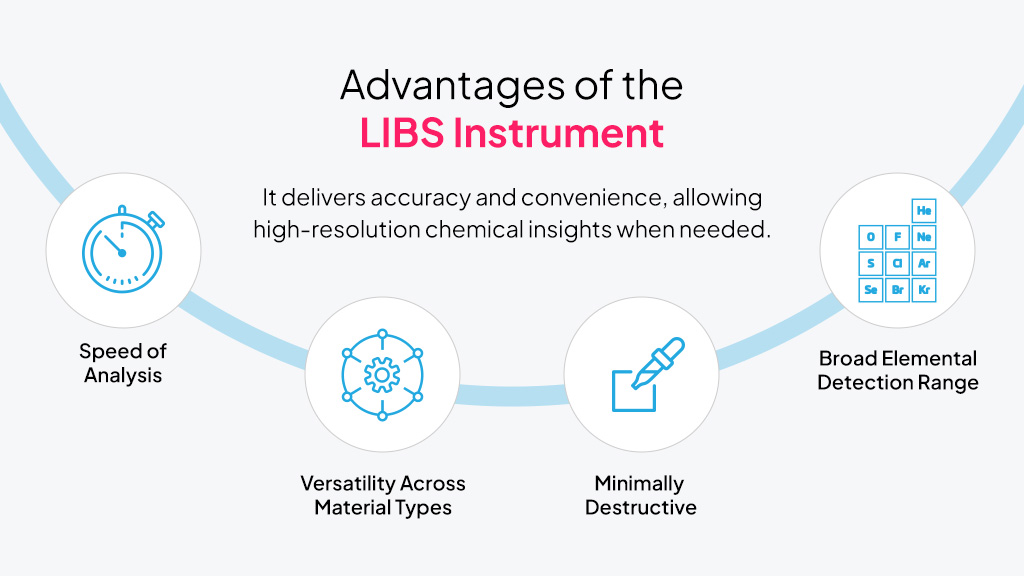
The growing use of LIBS across research and industry is driven by its distinct characteristics. It delivers accuracy and convenience, allowing high-resolution chemical insights when needed. Advantages of the technology include:
- Speed of analysis: LIBS measurements occur within seconds, providing near-instantaneous feedback. This capability supports on-site and in-line monitoring, so operators can make quick decisions during analysis. Rapid decision-making may improve production efficiency and data quality verification.
- Versatility across material types: LIBS can analyze solids, liquids, gases and mixed-phase materials, and can handle heterogeneous and irregular samples. This flexibility allows for integration into diverse workflows.
- Minimally destructive: The minimally destructive nature of LIBS is beneficial for hazardous or sensitive materials, as only a microscopic amount of material is ablated during analysis, and the samples remain largely intact.
- Broad elemental detection range: LIBS can detect nearly all periodic table elements, including light elements often inaccessible to other methods. The technique’s ability to detect multiple elements supports comprehensive material characterization in a single measurement.
Common Applications for LIBS Analysis
Because LIBS accommodates a wide variety of materials and requires minimal sample preparation, users have adopted it across multiple disciplines. Each field applies the technology to address specific analytical or operational challenges.
Environmental and Geological Surveying
In environmental science and geochemistry, LIBS enables rapid on-site elemental analysis of soils, sediments, rocks and water samples. The technique helps assess contamination levels and evaluate soil fertility.
LIBS is valuable in geological fieldwork because it provides compositional data that supports faster decision-making during exploration. The instrument can accurately detect trace metals and rare earth elements, which facilitates resource evaluation and environmental monitoring with high precision.
Industrial and Manufacturing Quality Control
Manufacturing sectors rely on LIBS for process control, alloy verification and contamination detection. For example, in metallurgy, the technology can confirm the composition of incoming materials or finished components to ensure compliance with specifications.
Because LIBS is noncontact and fast, users can integrate it into production lines for quality assurance. This capability supports uptime and enhances traceability.
Food and Agricultural Applications
In the food and agriculture sector, LIBS supports food authentication and contaminant analysis. Agricultural soils, fertilizers and crops can be analyzed on-site to evaluate nutrient balance or detect the presence of harmful metals.
LIBS provides an alternative to laboratory-based techniques that may require chemical reagents and extended turnaround times. For example, analyzing potassium, calcium and magnesium in soil samples in the field enables more responsive nutrient management and supports sustainable farming practices.
In food processing, LIBS contributes to authenticity and quality control. Researchers can use the instrument to distinguish geographical origin in agricultural products, detect adulteration in powders and liquids, and verify mineral composition in nutritional supplements.
Biomedical and Pharmaceutical Research
Biomedical and pharmaceutical research involves elemental mapping and trace analysis to provide insight into biological processes and product integrity.
In tissue studies, LIBS can map the spatial distribution of trace metals that influence cellular metabolism and disease progression. Its ability to perform these analyses without chemical staining or sectioning reduces interference and preserves sample integrity.
In the pharmaceutical domain, LIBS is crucial for ensuring the even distribution of active ingredients by verifying elemental uniformity in drug formulations. It also serves to detect any elemental impurities that might be introduced during synthesis or packaging.
Semiconductor Manufacturing
The semiconductor industry requires analytical methods capable of detecting trace contaminants at low concentrations. LIBS contributes to thin film characterization, wafer inspection and contamination control.
When configured with high-resolution optics and precision laser focusing, the technology can analyze micrometer-scale features and layered materials with high accuracy. Its ability to analyze nonconductive or composite substrates also supports quality assurance in advanced materials. Manufacturers can detect contamination early in the fabrication cycle by integrating LIBS into process monitoring systems.
Space Exploration
Deployed on space missions by space agencies, LIBS instruments are crucial for analyzing the composition of planetary surfaces. Researchers can use them to determine the elemental makeup of Martian rocks and soils, which helps guide decisions about sampling and exploration.
LIBS operates reliably under low-pressure atmospheres, extreme temperature variations and communication delays. These capabilities make the instrument valuable in remote applications.
Deep Ocean Analysis
Just as space exploration pushes the boundaries upward, deep ocean analysis tests LIBS performance under immense pressure and challenging optical conditions. Mounted on remotely operated vehicles or autonomous underwater platforms, LIBS systems can identify the elemental composition of submerged products and deposits.
Seawater may pose particular challenges for optical spectroscopy due to absorption and scattering. However, the plasma formed during LIBS ablation produces a strong enough localized signal that — with appropriate optical design — can mitigate these challenges.
Trust Us for LIBS Laser Solutions
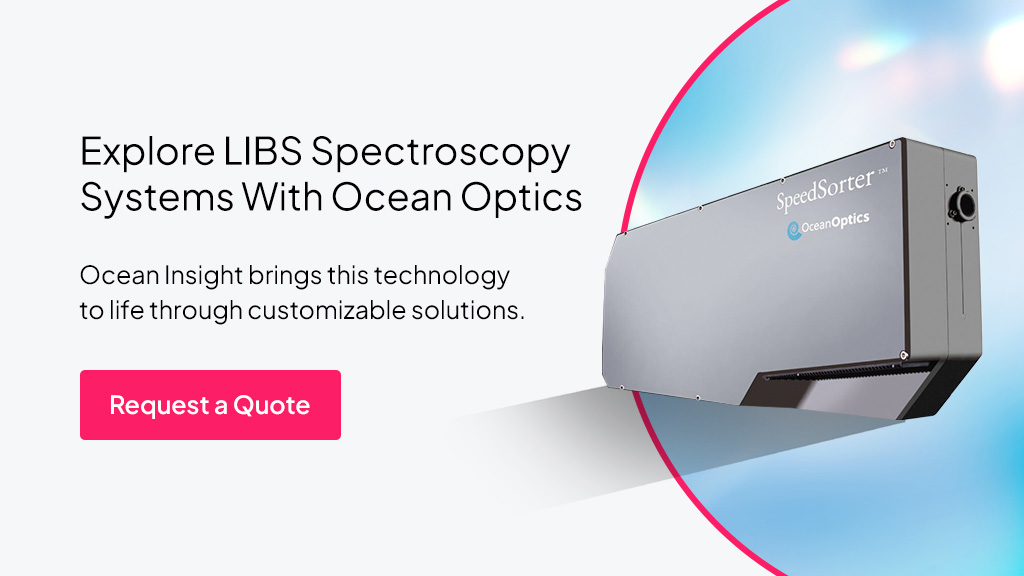
At Ocean Optics, we enable discovery. We harness the power of light to help you build a safer, cleaner and healthier world. Our high-throughput SpeedSorter™ is especially tailored for rapid separation of scrap metal at any scale. These sensors are designed to be installed in an automated material handling system where our sensors help drive high-speed recycling applications. We can design solutions for single-lane or multilane systems, helping you expand as your needs evolve.
Through our applied spectral knowledge (ASK) approach, we combine products, services, and expertise to solve real-world analytical challenges. Our team works with you to optimize system performance. Partnering with us provides you with advanced technology and dedicated support to transform data into actionable insights.
Explore LIBS Spectroscopy Systems With Ocean Optics
LIBS is redefining what’s possible in elemental analysis. Ocean Optics brings this technology to life through customizable solutions designed to help you explore and understand the materials that shape the world. Request a quote today.