
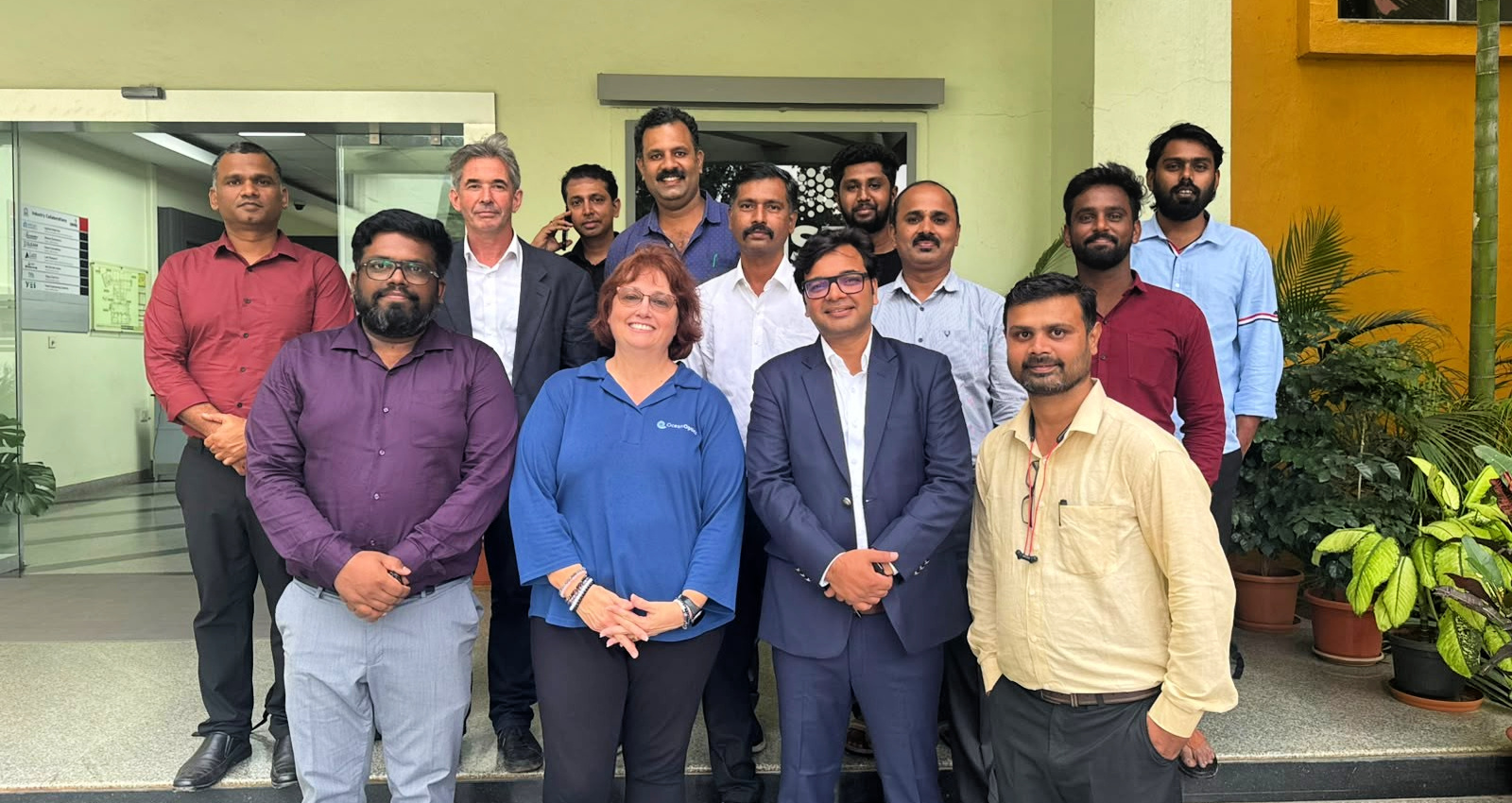
Spectroscopy may have brought Yvette Mattley, Ph.D. to India, but it was the researchers, their questions, and their ingenuity that made the journey memorable.
In her latest blog post, Yvette takes us from Mumbai to Bengaluru, sharing highlights from hands-on workshops, fascinating spectroscopy applications, and conversations with researchers who are finding new ways to turn spectral measurements into practical insights.
In September, I had the opportunity to travel through India with colleagues from Ocean Optics and our longtime distributor, Sinsil International. At events in Mumbai and Indore, we connected with researchers, faculty members, and students around a shared interest in spectroscopy. We concluded the trip with a full-day workshop at the Centre for Nanoscience and Engineering at the prestigious Indian Institute of Science (IISc) in Bengaluru.
Connecting Research Questions with Spectroscopy
Our goal for these workshops was to help researchers connect spectroscopy measurements with their own research questions. We began by explaining how modular spectrometers work and how key performance characteristics impact the measurements. We then moved from instrument fundamentals to typical research questions, showing how different spectroscopy approaches can help answer them. Each event concluded with a hands-on session where attendees could work directly with the spectrometers, ask questions about specific measurements, and explore how a modular system can be configured for different measurement types.
IISc Bengaluru: Bringing Research and Practice Together
At our final stop in Bengaluru, we held a full-day workshop organized with IISc and Sinsil International. The workshop brought researchers, spectroscopy users, and technology developers together for presentations, technical discussions, and hands-on demonstrations. The IISc workshop followed the same presentation sequence we used throughout the trip. Neville Davies opened with a presentation on “Choosing the Right Spectrometer,” explaining the performance characteristics and tradeoffs to consider when selecting an instrument. I followed with “Spectroscopy in Practice: From Research Questions to Measurement Solutions,” focusing on how to answer a research need with a modular spectroscopy measurement.
Learning from Guest Researchers
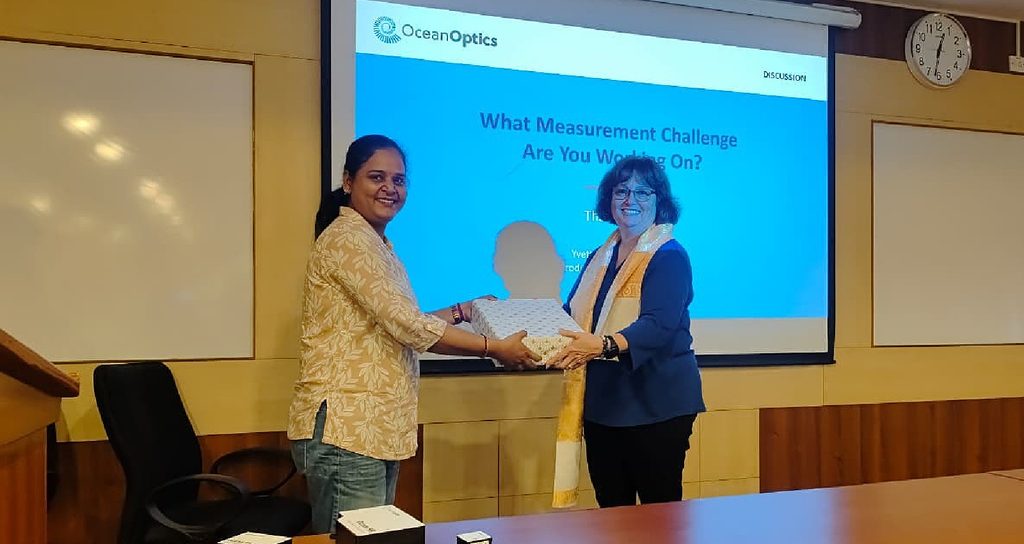
One of the most valuable parts of the IISc workshop was hearing directly from guest researchers about how they use modular spectroscopy in their own work. I especially enjoyed learning about these real-world applications and seeing how the measurement principles we discussed supported different research questions. Their presentations brought the workshop concepts to life and showed how researchers are using spectroscopy to move their projects forward.
Dr. Gurumurthy Hegde of Dayananda Sagar University presented “Optical Storage Devices and Tuning and Turning: How Spectroscopy Helps.” Dr. Hegde’s research connects photonics, advanced materials, and optical-device development, with spectroscopy providing insight into how material properties change during device tuning. He explored how spectroscopy can track changes in light-responsive materials as conditions or device parameters are adjusted. These measurements help researchers determine whether the optical properties are changing as intended during device development. What stood out to me was how spectroscopy links fundamental material behavior with the feedback needed to develop and tune optical devices.
Dr. Nagabhushan of Amity University Bengaluru presented “Emission Spectra of TLD Materials Using Ocean Optics Spectrometer.” Dr. Nagabhushan’s research applies spectroscopy to luminescent and radiation-sensitive materials, using emission measurements to investigate their behavior under different conditions. Thermoluminescent dosimeter (TLD) materials store energy after exposure to ionizing radiation and release part of it as light when heated. Measuring the wavelength and intensity of that light allows researchers to characterize and compare TLD materials across experimental conditions. I found it fascinating to learn how a compact spectrometer could capture this emission and reveal useful information about radiation-sensitive materials.
Dr. Jinesh Mathew of Gandhi Institute of Technology and Management (GITAM), Bengaluru campus, discussed “NIR Spectroscopy for Adulteration Detection.” Dr. Mathew is a recognized expert in photonics and fiber optic sensing, combining academic leadership, research innovation, and industry collaboration at GITAM Bengaluru. He showed how near-infrared spectroscopy can rapidly and non-destructively screen food and other materials for compositional differences related to adulteration. Because those differences can be subtle, reliable screening requires representative reference samples and a calibration or classification model validated for the samples and adulterants of interest. His presentation made clear that the speed of NIR screening is most valuable when it is supported by careful calibration and validation.
During the hands-on session, I also met Dr. Rajesh Cheruku of Dayananda Sagar University, who showed me a broadband optical monitoring system his students are developing for thin-film deposition and multilayer optical coatings. Dr. Cheruku combines thin-film research, optical instrumentation, and software development, working with students to translate real-time spectral measurements into practical process-monitoring tools. Their platform pairs an Ocean Optics spectrometer with custom software built using the Ocean Direct Software Developer’s Kit. The custom software includes calibration, acquisition and spectral processing in real time, and conversion of the spectral data into film-thickness values during deposition. It was exciting to see the students use Ocean Direct to implement thin-film calculations and transform spectroscopy data into a practical process-monitoring tool.
Taken together, these researchers showed the remarkable range of questions that spectroscopy can help address—from tuning optical materials and characterizing radiation-sensitive compounds to detecting adulteration and monitoring thin-film growth. I was grateful that they shared not only their research, but also the thinking, experimentation, and ingenuity behind it. Their stories were a highlight of the workshop and a powerful reminder that the most meaningful technical conversations begin with the people doing the work.
From Presentations to Hands-On Exploration
In the afternoon, participants moved from the presentations to hands-on exploration. They worked through absorption, transmission, fluorescence, plasma monitoring, thin-film characterization, materials analysis, near-infrared analysis, and optical-source measurements. The demonstrations gave attendees time to test ideas, discuss their own samples and research questions, and see how a small set of modular components could support many different measurement approaches. The energy in these sessions reflected what made the entire trip so rewarding: researchers were not simply observing spectroscopy demonstrations – they were actively considering how the techniques could advance their own research.
Looking Ahead
Throughout the trip, I saw spectroscopy applied to material characterization, optical-device development, adulteration screening, and real-time process monitoring. I returned with new ideas and fresh appreciation for the flexibility of Ocean Optics spectrometers and software, especially when researchers adapt the same modular tools to different measurement needs. Most of all, I look forward to seeing where these researchers take their work – and how spectroscopy will help them get there.
This amazing trip also gave me memorable glimpses of India beyond the workshops. In Mumbai, our hosts welcomed us into their homes, shared delicious homemade meals and masala tea, and introduced us to the Ganesh Chaturthi celebrations taking place throughout the city. Those experiences—and the warmth and generosity of the people I met—made the journey even more meaningful. They added a personal dimension that will stay with me long after the technical sessions ended.