
A customer-facing overview of reflectance theory, key hardware selections, and an example modular system configuration for color and material analysis.
Ocean Optics modular spectrometers and accessories can be configured for a wide range of diffuse and specular reflectance measurements—from feasibility studies in the lab to quality control and process monitoring in production environments.

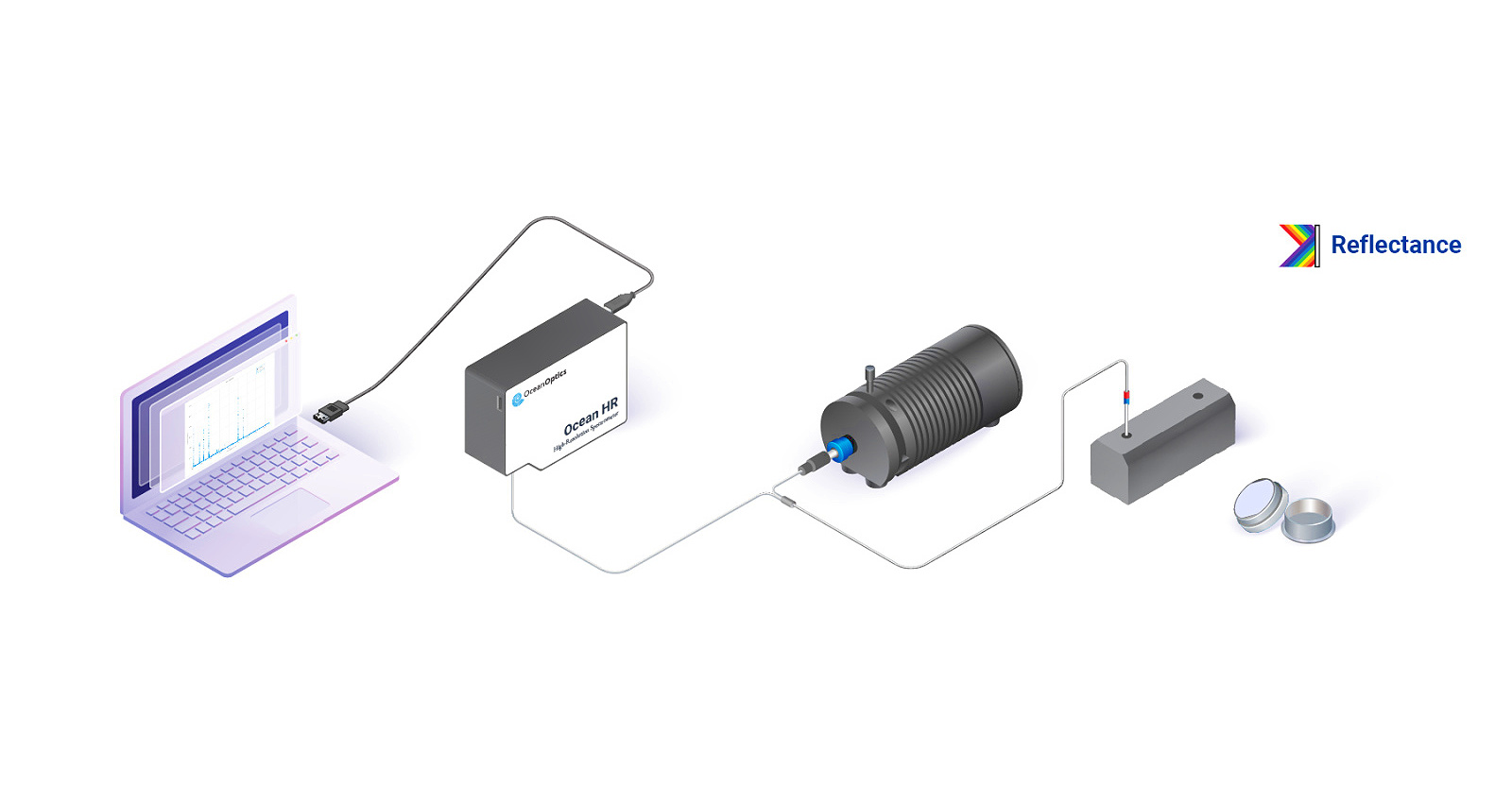
This example uses a reflection probe as the sampling device. The tablet shown is a stand-in for laptop PCs and other computing devices. The configuration shown is only one example of the many reflectance and color measurement setups possible with Ocean Optics spectrometers and accessories.
Reflectance Measurement Setup at a Glance
| Item | Description | Quick Tip |
| Spectrometer | A workhorse spectrometer like the Ocean SR and Ocean HR are good choices for many applications, including reflectance and color measurements. The NR spectrometers cover near-infrared requirements from 900 – 2500 nm. | If you’re using an integrating sphere for sampling, you might consider selecting one of our enhanced-sensitivity spectrometer upgrades. |
| Light Source | Your choice of light source depends on the wavelength range of interest. The broad, smoothly varying output of a tungsten halogen source is ideal for reflectance at visible wavelengths, and for sorting or color applications. The HL-2000 series is the choice here, with standard, long-life and high-power versions available. | The HL-2000-HP-FHSA is the most versatile of our tungsten halogen sources, with high power output and a convenient built-shutter for dark readings. |
| Sampling Optics | Reflection probes can be positioned to measure specular and diffuse reflectance, or backscatter. Reflection probes illuminate and detect from the same direction, so they read only part of the reflected light. | We highly recommend adding an RPH-1 or comparable probe holder, which positions probes at 45° or 90° to flat surfaces. |
| Sampling Optics | An integrating sphere is a good idea if the reflectivity of the sample seems to change at different viewing angles. The sphere has a 180° view of the reflected light. | Our ISP-REF series spheres have an integrated light source. Also, if you select an integrating sphere for sampling, you’ll need to add an optical fiber(s) to connect to the spectrometer. |
| Reflectance Standards | Reflectivity is typically measured relative to a reference standard. We offer diffuse and specular standards (both high- and low-reflectivity options). | WS-1 series reflectance standards are available with Spectralon or PTFE diffusing materials. |
| Software | OceanView spectroscopy software is our signature desktop spectroscopy application. | Generate, edit and export spectral process flow diagrams with the Schematic View of OceanView |
Reflectance
Reflectance is light incident on the surface of a material that is reflected at an interface. Light not reflected from the sample is absorbed, scattered, or transmitted. Very smooth or shiny, mirror-like surfaces have high specular reflectance, in which the incident light reflects in the same direction. Rough or matte surfaces have diffuse reflectance, where the incident light gets scattered in all directions. Most surfaces exhibit a combination of specular and diffuse reflectance.
Advantages of Reflectance
- Non-destructive measurements: Most sample types can be measured repeatedly without affecting the sample.
- Quantitative technique: Reflectance is more accurate than the human eye for determining sample color or examining differences among objects.
- Diverse applications: Systems can be configured for specular and diffuse measurements of samples such as auto parts, paint and coatings, coffee beans and fruit, and biospecimens.
Spectrometer Setup for Reflectance
Ocean Optics modular spectrometers and accessories can be configured for a variety of diffuse and specular reflectance measurements, with options for lab use, feasibility work, quality control, and process monitoring. These are the core components to consider for most applications.
Spectrometers
Workhorse spectrometers like the Ocean SR and HR are good choices for many applications including reflectance and color measurements. The NR spectrometers cover near-infrared requirements from 900 – 2500 nm.
When selecting a spectrometer, choose the model that matches the wavelength range of interest. Preconfigured versions of most spectrometers are available with VIS-NIR wavelength range options (which vary by spectrometer model) and are well suited to many reflectance applications.
For industrial applications, a complete solution may be the best fit. Ocean Optics can help integrate an SR6 as a component, subsystem, or complete system into a process line when reflectance or color must be measured in challenging environments.
Light Sources
The most important consideration in choosing a light source for reflectance is strong output over the wavelength range of interest. For color measurements, or when making a measurement intended to mimic the human eye, the light source should cover 380–780 nm. For the chemical composition of organic materials, near-infrared or infrared light often provides more information. Except in a few very specific cases, a narrow light source will not offer enough useful information, so lasers and many LEDs can typically be ruled out.
Visible light sources
The broad, smoothly varying output of a tungsten halogen light source is ideal for reflectance at visible wavelengths and for sorting or color applications. The HL-2000 series is the typical choice, with standard, long-life, and high-power versions available. The HL-2000-HP-FHSA model is especially useful because it combines a high-power bulb with a built-in shutter and attenuator for taking dark measurements and adjusting light levels without disturbing the setup.
UV-visible light sources
Both deuterium-tungsten and xenon light sources can be used for UV-Vis reflectance measurements, but each has different strengths. Deuterium-tungsten light sources offer a broad, smoothly varying spectrum and stable output from 190–2500 nm. Because their output comes from two different bulbs, the UV and visible portions of the spectrum can be used separately.
In contrast, xenon light sources have very jagged and pulsed spectra. They provide good UV output, but spectral averaging is necessary to obtain quality measurements. Xenon sources can also be useful for field UV reflectance measurements because they can run on 12 VDC power.
NIR light sources
HL-2000 series sources also provide output into the NIR, out to approximately 2500 nm. Even though intensity decreases at longer wavelengths, that effect is offset by higher detector sensitivity in Ocean Optics NIR spectrometers at those wavelengths.
Sampling Optics
The choice of sampling accessory depends on whether the application requires specular or diffuse reflectance, whether the sample is flat or irregularly shaped, and how much of the reflected light must be captured.
Reflection probes
A reflection probe is an excellent choice for quick measurements and for applications where a small spot size needs to be sampled. Probes can be positioned to measure either specular or diffuse reflectance and are compatible with Ocean Optics spectrometers and light sources, provided the probe fiber bundle matches the wavelength range of the light source.
The limitation of a reflection probe is that it illuminates and detects from the same direction, so it sees only part of the reflected light. Measurements made with a reflection probe are therefore relative. Probe holders are available for fixturing the probe at 90° or 45° to the sample surface.
Integrating spheres
An integrating sphere is a good option if the apparent reflectivity of a sample changes with viewing angle. This often occurs with rough surfaces such as brushed metal and plastic parts, fish scales, and grains. An integrating sphere has a 180° view of reflected light and can also be used for convex curved surfaces or for measuring the color of objects small enough to fit into the sphere. Ocean Optics integrating spheres view a 6 mm or 8 mm spot size on the sample.
The integrating sphere works because of its perfectly diffusing interior surface. Light enters through a circular input port and is scattered repeatedly by the sphere’s inner wall until the light inside the sphere becomes uniform, regardless of spatial, angular, or polarization variations in the input. A fiber positioned at 90° to the input port samples a small fraction of the light within the sphere and sends it to the spectrometer. A baffle in front of the fiber port helps block light rays making their first reflection from the sample port.
Collimating lenses
Collimating lenses can be added to optical fibers to customize the angle of incidence and angle of collection in reflectance measurements. Both specular and diffuse reflectance can be measured this way, but the method requires more alignment up front and usually additional fixturing.
The collimating lenses must be adjusted carefully to avoid beam divergence and achieve good signal, making this a more time-consuming method. In practice, color measurements made using collimating lenses and fibers are often less accurate than measurements made using an integrating sphere because they are more difficult to manipulate with precision.
Reflectance Standards
A reflectance system is not complete without a reference standard. Reflectance measurements are a ratio of the reflected light spectrum to the incident light spectrum. Since there is no way to collect all the light incident on a surface, reflectivity is usually measured relative to a reference standard.
The reflectance standard selected should be similar in reflectivity to the sample being measured. Keeping signal levels similar during measurements helps achieve the best signal-to-noise performance.
Diffuse reflectance standards
The WS-1 diffuse reflectance standard has a PTFE diffuser, is matte white in color, and is greater than 98% reflective from 250–1500 nm. The WS-1-SL uses Spectralon diffusing material and can be a good choice when working in the field or in contaminated environments, since it can be smoothed, flattened, and cleaned if it becomes pitted or dirty.
Specular reflectance standards
The STAN-SSH high-reflectivity specular reference standard is the preferred choice when measuring very shiny surfaces, but its reflectivity varies from 85%–98% over its 250–2500 nm range. This can be corrected in OceanView software by uploading the reflectance values and correcting for the reflectivity of the standard. This data comes automatically with the STAN-SSH-NIST calibrated reference standard. If no correction is applied, OceanView assumes the standard is 100% reflective at all wavelengths, which can distort the data.
At the other extreme, the STAN-SSL low-reflectivity specular reflectance standard is best for surfaces with low specular reflectance, such as thin film coatings, anti-reflective coatings, blocking filters, and substrates. It has approximately 4.0% reflectance from 200–2500 nm.
Example Reflectance Measurement Setup
The sample system shown above uses a probe as the sampling device. The tablet shown in the illustration is a stand-in for laptop PCs and other computing devices. This is only one example of dozens of different reflectance and color measurement configurations possible with Ocean Optics spectrometers and accessories.
In this configuration, a general-purpose spectrometer collects spectral data, a tungsten halogen light source provides broadband illumination, and a reflection probe with a holder delivers light to the sample and collects reflected light for analysis. A reflectance standard is used to normalize measurements and improve accuracy.
In operation, the light source illuminates the sample through the reflection probe. The probe captures the reflected light and transmits it to the spectrometer, which resolves the signal into spectral components. Software compares the measured signal to the reflectance standard to calculate relative reflectance. This modular approach allows configurations to be adapted for diffuse or specular measurements, for UV, VIS, or NIR wavelength ranges, and for laboratory, field, or industrial environments.
Conclusion
Reflectance spectroscopy is a powerful, non-destructive technique for evaluating surface properties, color, and material behavior. By pairing the right spectrometer, light source, sampling optics, and reference standard, users can configure systems for a wide range of applications—from benchtop feasibility studies to industrial process monitoring.
Ocean Optics modular solutions make it possible to tailor reflectance systems to the sample, geometry, wavelength range, and speed requirements of the measurement while maintaining accuracy and repeatability.