
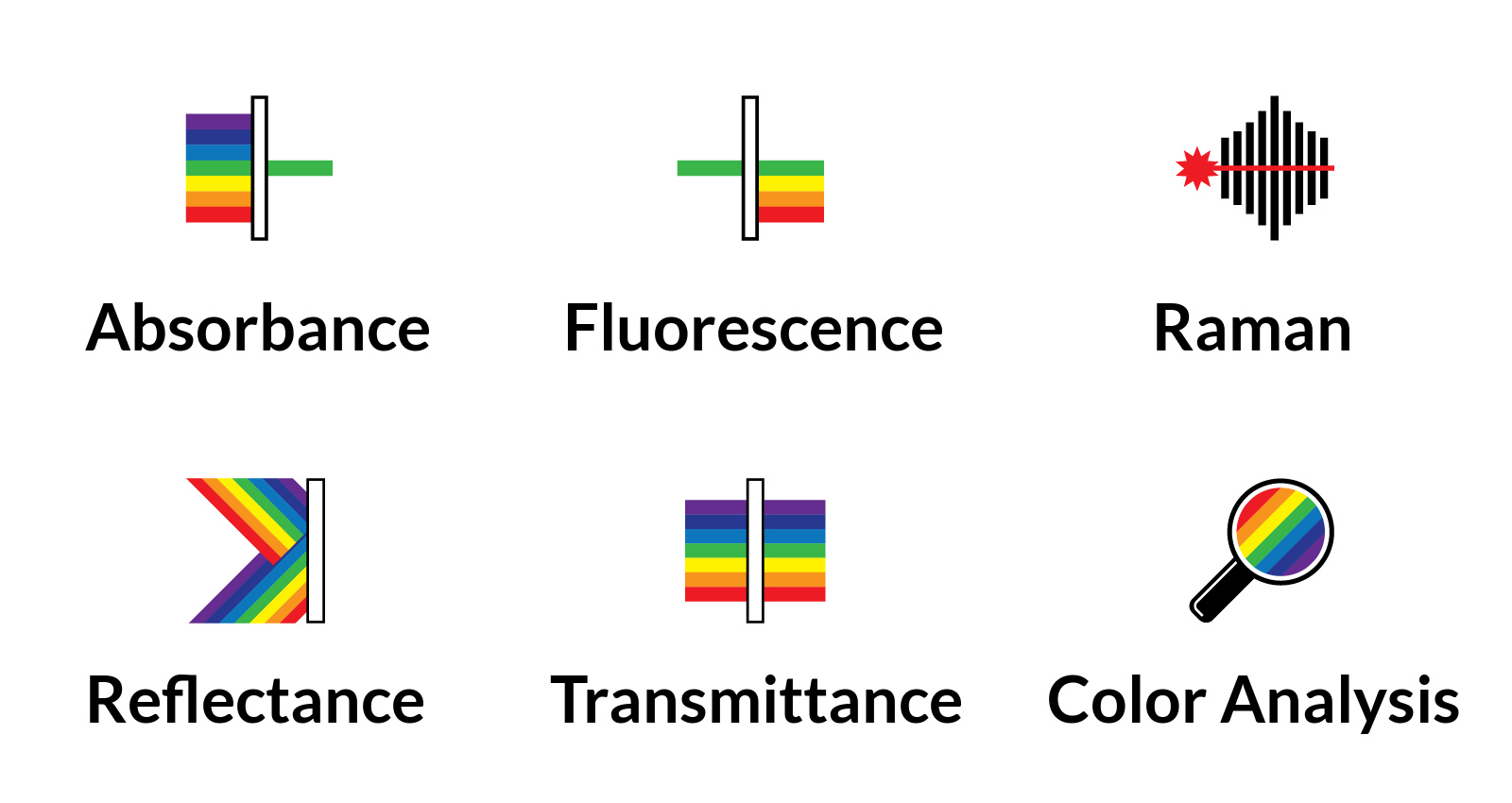
Choosing the right spectroscopy technique starts with understanding what you need to learn about your sample. Choose UV-Vis absorbance when your analyte has characteristic absorption in the UV-visible range, NIR when bulk sample composition is the measurement objective, Raman when you need a molecular fingerprint, and fluorescence when your target produces a measurable fluorescent signal. The appropriate choice depends on your sample, the information required, and the conditions under which you must measure.
Ocean Optics supports spectroscopy technique selection with modular spectrometers and application-specific configurations. This blog post looks at three key decisions: which measurement technique provides the information you need, which wavelengths contain that information, and which sampling setup produces a usable signal.
Spectroscopy techniques compared at a glance
Your measurement objective determines which technique to evaluate first. Use this table to identify which approaches are best suited to your sample and the information you need.
| Approach | Measurement objective | Wavelength consideration | Sample examples | Key consideration |
| UV-Vis absorbance | Concentration or absorbance of a target analyte | Cover the analyte’s UV or visible absorption features | Solutions, biofluids, optical materials | Background absorption, scattering, and pathlength |
| NIR spectroscopy | Composition or quantitative analysis of bulk materials | Choose coverage around the informative NIR bands | Powders, liquids, foods, polymers | Overlapping bands and need for calibration models |
| Raman spectroscopy | Molecular identification and structural information | Select the excitation wavelength and ensure adequate Raman shift coverage | Materials, chemicals, pharmaceutical samples | Weak Raman signal, fluorescence interference, and reference spectra for identification |
| Fluorescence spectroscopy | Detection or quantification of fluorescent compounds | Match excitation to absorption and detection to emission | Biological samples, dyes, authentication samples | Excitation rejection and sample-dependent fluorescence response |
Reflectance and transmittance describe how you collect light (measurement modes), not separate wavelength regions. Both can be used across different spectral ranges, depending on the light source, optics, sample, and detector.
UV-Vis vs NIR spectroscopy: Which range fits your measurement?
UV-Vis is a good starting point for analytes with characteristic absorption in the UV or visible range, while NIR is useful for measuring sample composition based on molecular vibrational overtones and combination bands. The key difference is the type of spectral information needed for your measurement, not simply the wavelength range of the instrument.
When to choose UV-Vis absorbance
Consider UV-Vis for concentration measurements, protein and nucleic acid analysis, and characterization of absorbing optical materials. The analyte must have an absorption feature that can be distinguished from the sample background, and the concentration and optical pathlength must allow enough light to reach the detector.
Ocean Optics supports these measurements with configurable absorbance systems. Before selecting hardware, consider the wavelength range of interest, blank or reference requirements, expected absorbance range, and required measurement repeatability.
Keep in mind that a spectrometer’s wavelength range may extend beyond UV-Vis. For example, a spectrometer covering 190-1100 nm extends into the NIR, even though it may be used primarily for UV-Vis measurements.
When to choose NIR spectroscopy
Consider NIR for measuring moisture, fat, protein, or other compositional properties in samples such as foods, powders, liquids, and polymers. Broad, overlapping absorption bands often require chemometric analysis to extract useful compositional information.
Ocean Optics NIR spectrometers include NR configurations covering 900 to 1700 nm, 900 to 2200 nm, and 900 to 2500 nm. Select a wavelength range that captures the spectral features relevant to your measurement.
Extending the wavelength range can provide access to additional absorption features, but wider coverage does not necessarily improve measurement performance. Consider the spectral features of interest, sample characteristics, and measurement requirements when selecting an NIR range.
Raman vs fluorescence: Which signal answers your question?
Raman measures molecular vibrations through inelastic scattering, while fluorescence measures light emitted following optical excitation. Choose Raman for molecular identification and structural information, and fluorescence for detecting or measuring fluorescent compounds or labels.
Raman for molecular identification
Raman can support material identification and reaction monitoring, but the weak Raman signal can be obscured by fluorescence. Choosing an excitation wavelength requires balancing Raman signal strength, fluorescence interference, and the spectral range needed for the measurement.
Ocean Optics Raman spectrometers offer excitation-specific configurations, including 532, 638, 785, 830, and 1064 nm options across the product family. Raman shift range and spectral resolution vary by configuration, so select a system based on the features important to your application.
Longer excitation wavelengths can reduce fluorescence interference in some samples, but Raman signal strength and detector response also vary with wavelength. The best excitation wavelength depends on the sample and measurement requirements.
Fluorescence for emission-based measurements
Fluorescence measurements rely on a fluorescent analyte or label, with excitation and detection selected around its spectral response. Because fluorescence emission typically occurs at longer wavelengths than excitation, the excitation source and detection range should be selected separately.
A fluorescence measurement may also require appropriate filters and sampling optics to minimize excitation light reaching the detector. Sensitivity depends on the fluorescent species, sample background, optical configuration, and measurement conditions.
For quantitative Raman and fluorescence measurements, the instrument response function can also affect measured intensities. Relative intensity correction accounts for this response and supports more reproducible comparisons between measurements. NIST provides relative intensity standards for fluorescence and Raman spectroscopy for this purpose. In OceanView software, relative irradiance mode measurements are used to account for instrument response function to provide a more accurate representation of spectral shape.
Choosing between absorbance, transmittance, and reflectance
Choose transmittance when you want to measure light passing through a sample, absorbance when you want to measure how much light the sample absorbs, and reflectance when you want to measure light returned from a surface. The sample’s optical properties and your measurement objective help determine the most appropriate sampling geometry.
Liquids and transmitting materials
Solutions and transmitting materials can be measured with a defined optical path between the source and detector. For concentration measurements, pathlength, reference measurements, and consistent sample presentation are important. Scattering and background absorption can also affect the measurement.
Opaque solids and surfaces
Reflectance is useful when measuring light through the sample is impractical. The measured signal depends on surface properties and collection geometry as well as composition, so consistent sample positioning, illumination, and collection are important when comparing samples.
Changing from transmittance to reflectance does not necessarily require a different spectral range. The appropriate wavelength range depends on the spectral features of interest, while the sampling geometry determines how light is delivered to and collected from the sample.
How to choose your wavelength range
Choose a wavelength range that contains the spectral features needed for your measurement and that your complete optical system can measure effectively. Consider the following factors before selecting a spectrometer.
- Identify the important spectral features. Use reference spectra or preliminary measurements to identify absorption bands, emission features, or Raman shifts relevant to your analyte or measurement.
- Define the required wavelength coverage. Include relevant background and neighboring features needed for interpretation or modeling, rather than simply choosing the widest available range.
- Consider the complete optical system. The light source, fibers, filters, windows, and sampling accessories must support the wavelengths of interest.
- Check detector performance. Consider detector response and noise at the wavelengths important to your measurement, particularly near the beginning and end of the spectral range.
- Balance resolution, sensitivity, and speed. Consider how closely spaced your spectral features are, the expected signal level, and the acquisition time available for the measurement.
Ocean Optics offers light sources for UV, visible, and NIR illumination and for excitation-based measurements. The useful output of the light source should overlap the wavelength range required for the measurement. Spectrometer coverage alone does not ensure adequate illumination.
For closely spaced spectral features, consider Ocean Optics high-resolution spectrometers. Optical resolution depends on the spectrometer configuration, including grating and entrance slit selection, so wavelength range and resolution should be considered together.
For low signal levels, consider Ocean Optics high-sensitivity spectrometers. Sensitivity, integration time, and measurement speed are related, so the appropriate configuration depends on the signal level and acquisition time available for the application.
Choose a technique by application
The information you need from the sample is often more important than the application or industry alone. Similar samples may require different techniques depending on whether the goal is to measure concentration, determine composition, or identify a material.
- Biological research: Consider absorbance for protein and nucleic acid concentration measurements and fluorescence for measurements involving fluorescent molecules or labels. The appropriate technique depends on the assay, sample, and information required.
- Materials identification: Consider Raman for molecular identification and NIR for composition or classification based on spectral differences between materials.
- Food quality: Consider NIR for measurements such as moisture, fat, and protein content. Fluorescence can address different questions, including authentication and detection of adulteration.
- Process and OEM systems: Start with the required measurement, then consider measurement speed, environmental conditions, sampling requirements, and system integration.
Ocean Optics’ food spectroscopy resources show how different spectroscopy techniques can support applications including authentication, quality assessment, and sorting. The most appropriate technique depends on the sample and the information required from the measurement.
Translate your requirements into a spectrometer configuration
Once you have identified the appropriate technique, translate your measurement requirements into a spectrometer configuration. Consider the sample, wavelength range, sampling geometry, resolution, sensitivity, and acquisition speed, along with any calibration or reference requirements.
The Ocean Optics guide to spectrometer selection overs the next step: choosing a spectrometer based on the performance requirements of your application.
For challenging measurements, an Ocean Optics Application Scientist can help evaluate the sample, measurement requirements, and appropriate system configuration.
Frequently asked spectroscopy comparison questions
What is the difference between UV-Vis and NIR spectroscopy?
UV-Vis measures electronic absorption, while NIR measures absorption associated with molecular vibrational overtones and combination bands. The right choice depends on the spectral information needed for your measurement and the characteristics of your sample.
When should I choose Raman instead of fluorescence?
Choose Raman when you need molecular fingerprint information. Choose fluorescence when a fluorescent compound or label provides the information you need. Because sample fluorescence can interfere with Raman measurements, excitation wavelength is an important consideration when selecting a Raman system.
Does a wider wavelength range always improve the measurement?
No. Additional wavelength coverage is useful when it captures spectral features relevant to your measurement, but a wider range alone does not improve sensitivity, resolution, or measurement performance. Choose the range based on the spectral features you need to measure and the performance required by your application.
Can one spectrometer support several techniques?
Yes. One of the key advantages of modular spectroscopy is the flexibility to use a small set of components for different types of measurements. A spectrometer can often be paired with different light sources, fibers, sampling optics, and accessories to support multiple applications. However, wavelength range, resolution, sensitivity, and other performance requirements vary by application, so a single configuration may not be optimal for every measurement.
Are reflectance and transmittance alternatives to NIR?
No. Reflectance and transmittance describe how light is measured from a sample, while NIR describes a spectral region. NIR measurements can use reflectance or transmittance depending on the sample and application. Choose the wavelength range based on the spectral information you need and the sampling geometry based on how light can be measured from the sample.
Have a Spectroscopy Question?
Sometimes the best way to choose a technique is simply to talk through the measurement. If you have questions about your sample, wavelength range, measurement setup or which spectroscopy technique to consider, our team is to help.